A feasibility study where every number is computed or cited.
Describe your business in a sentence, or enter your own numbers step by step. A tested finance engine calculates every figure, and every outside fact carries its source. The preview is free; you pay only to unlock the full report.
One line is enough; we then ask only for what's missing.
- The preview is free
- No card to start
- Your data is stored in the EU
Computed or cited. Nothing in between.
Language models write convincing prose and invented numbers. In Pruvas the AI writes no figure at all: financial numbers come from the engine, and outside facts come with their sources.
Computed
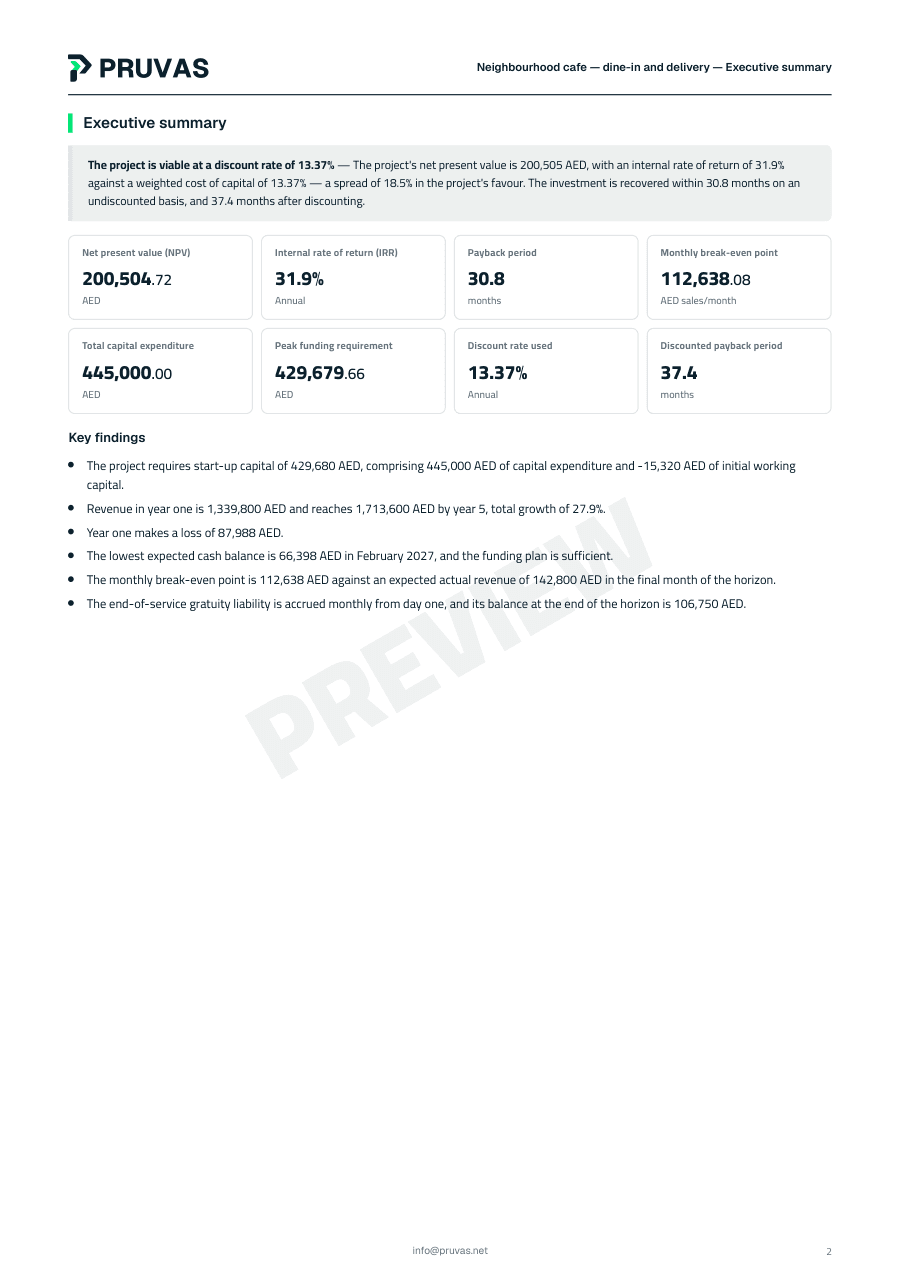
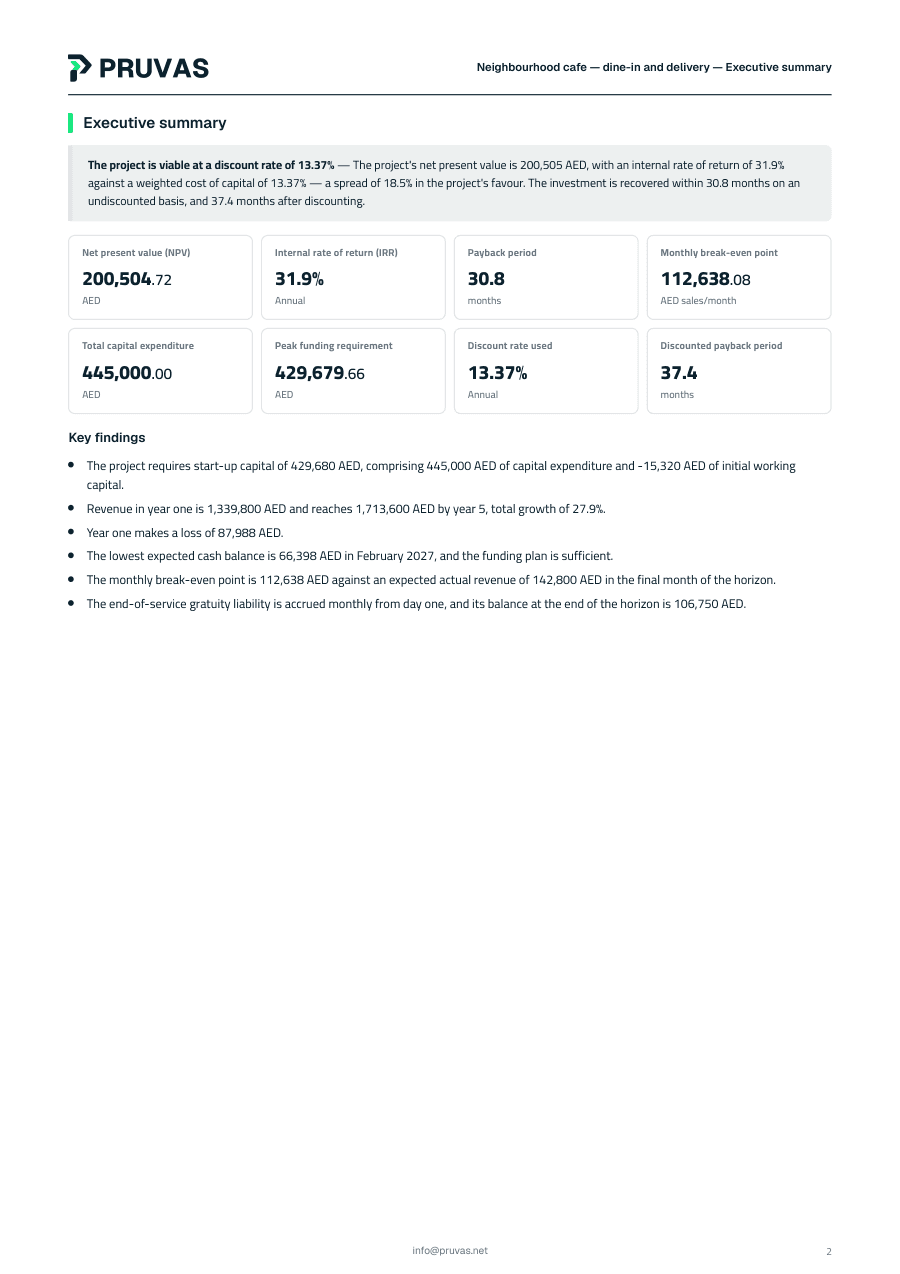
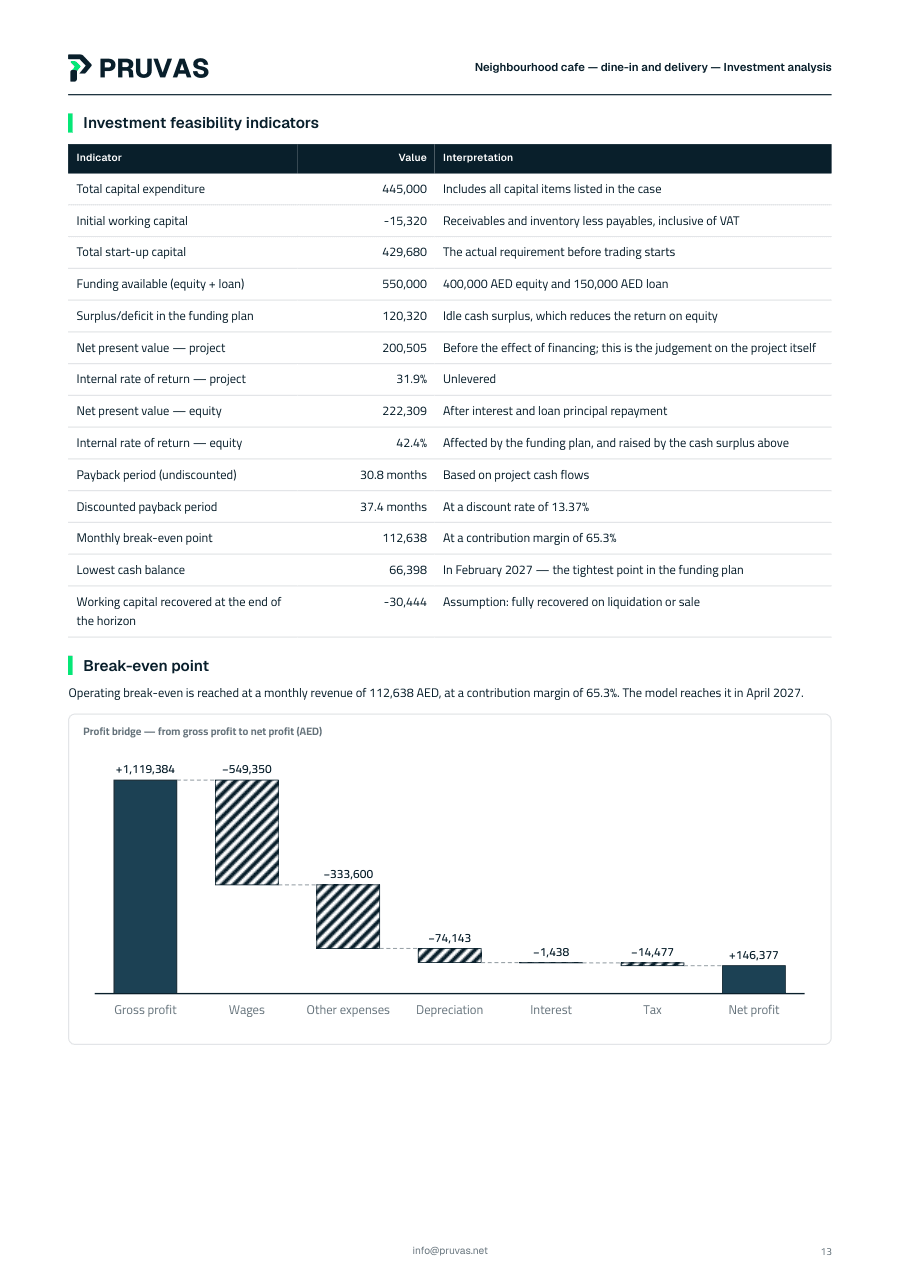
- Net present value — project
- 200,504.72AED
- Monthly cash flows, discounted at the derived 13.37%
- Internal rate of return — project
- 31.9%
- Against a weighted cost of capital of 13.37%
- Lowest cash balance
- 66,397.84AED
- Month 5 (February 2027): the tightest point before cash recovers
- Break-even revenue a month
- 112,638.08AED
- The monthly revenue that covers fixed costs in the mature year
From the bundled demo case, as the engine computed it.
Cited
- [1]
End-of-service gratuity for non-Omani employees
Article 61 — Labour Law issued by Royal Decree 53/2023, which repealed the Labour Law issued by Royal Decree 35/2003 with effect from 31 July 2023
- [2]
The repealed end-of-service gratuity rule for service before 31 July 2023
Article 39 — repealed — The repealed Labour Law issued by Royal Decree 35/2003
- [3]
Savings scheme for non-Omani employees, replacing the end-of-service gratuity
Article 139(1) — Social Protection Law issued by Royal Decree 52/2023, as amended by Royal Decree 60/2025
The rule is enforced, not claimed: a validator rejects any narrative that contains a figure the engine did not produce, an unknown value, or a citation without a source. The engine itself is tested against an independent finance library, with mutation tests that prove the tests can fail.
How it works
Three steps from an idea to a report a bank can read.
- 1
Describe or enter
Write your idea in a sentence and we draft the study, or enter your numbers step by step. Every change saves itself.
- 2
See the free preview
Your headline figures and the computed pages of your report, watermarked.
- 3
Unlock the report
We research your market and write the narrative, citing every fact.
Oman: the law, modelled to the article
In Oman, employer obligations are calculated as the law sets them, with their effective dates inside your study's horizon, and the decree and article behind every rule. Where an article number could not be verified, the report says so rather than inventing one.
Law as read on 19 September 2026.
Everywhere else: your rates
Any other country runs on the general model: you enter the corporate tax, VAT and labour rates, and the report says plainly which rules are not modelled.
| Rule | Source | In the model |
|---|---|---|
| End-of-service gratuity for non-Omani employees | Article 61Labour Law issued by Royal Decree 53/2023, which repealed the Labour Law issued by Royal Decree 35/2003 with effect from 31 July 2023 | On termination of the employment relationship, the employer must pay an employee who does not benefit from the Social Protection Law a gratuity for their period of service of not less than the basic wage for each year of service, calculated on the last basic wage, and the employee is entitled to the gratuity for fractions of a year in proportion to time served. As applied in this study: the basic wage divided by 12 for each month of service, at a flat rate that does not step up with length of service, and the article sets no minimum qualifying period, so entitlement begins from the first month. |
| The repealed end-of-service gratuity rule for service before 31 July 2023 | Article 39 — repealedThe repealed Labour Law issued by Royal Decree 35/2003 | The gratuity used to be calculated at 15 days' wage for each of the first three years of service, then one month's wage for each following year. The Ministry of Labour clarified on 23 October 2024 that periods of service before 31 July 2023 are calculated under this repealed rule, with what is due under Article 61 for the subsequent period added to it. It does not apply to this project because employment begins after that date, and it was not applied in the calculations. |
| Savings scheme for non-Omani employees, replacing the end-of-service gratuity | Article 139(1)Social Protection Law issued by Royal Decree 52/2023, as amended by Royal Decree 60/2025 | A monthly contribution of 9% of the basic wage for the non-Omani insured person, replacing the end-of-service gratuity provided for in Article 61 of the Labour Law. Its application was deferred to 19 July 2027 by Royal Decree 60/2025, and that date falls inside the study horizon. It has been applied in this study's calculations: the end-of-service gratuity stops accruing for the non-Omani employee from that date, and is replaced by a monthly cash contribution of 9% of the basic wage until the end of the horizon. |
| Employer social-insurance contributions — Omani employee | Contribution provisions — article number not verifiedSocial Protection Law issued by Royal Decree 52/2023 and its implementing decisions, in force from 1 January 2024 | The employer's total share is 14.5%, distributed as follows: 11% old-age, disability and death insurance, and 1% work-injury and occupational-disease insurance, with both of these two branches subject to a contribution-wage ceiling of OMR 3,000 per month; 0.5% job-security insurance, 1% maternity-leave insurance, and 1% sick and extraordinary leave insurance, with these three branches uncapped. The employee's share is 8% and is not part of the employer's cost. Note: unofficial sources vary in how they break down these percentages, and confidence in this breakdown is medium. |
| Employer social-insurance contributions — non-Omani employee | Provisions on the start of insurance programmes — article number not verifiedSocial Protection Law issued by Royal Decree 52/2023, as amended by Royal Decree 60/2025 | The employer bears 2%: 1% maternity-leave insurance, in force since July 2024, and 1% sick and extraordinary leave insurance, in force since July 2026 after being deferred by a year under Royal Decree 60/2025. Non-Omanis are not covered by old-age, disability and death insurance. A further 1% for work-injury and occupational-disease insurance is added from 19 July 2028 under Royal Decree 60/2025, bringing the rate to 3%. This effective date falls inside the study horizon, and it has been applied in the calculations month by month. |
| Basis for calculating contributions in this model | —Methodological note related to Social Protection Law 52/2023 | The statutory contribution wage is the basic wage plus fixed allowances, and the maternity and sick-leave insurances are calculated on the gross wage. However, this model's calculation interface only accepts the basic wage, so all rates have been applied to the basic wage alone, which understates the estimated cost of contributions wherever allowances exist. |
| Corporate income tax | Provision setting the tax rate — article number not verifiedIncome Tax Law issued by Royal Decree 28/2009, as amended by Royal Decree 9/2017 | The tax rate is 15% of the taxable base. Royal Decree 9/2017 raised the rate from 12% to 15% and abolished the exemption for the first OMR 30,000 slab, so that exemption no longer exists today. A reduced rate of 3% exists for small establishments and companies meeting conditions on capital, revenue, headcount and the nature of the activity, and it has not been applied here because its conditions are not met and its data are not available to the calculation function. Losses do not generate a negative tax, and loss carry-forward is not accounted for in this function. |
| Value added tax | Provision setting the standard rate — article number not verifiedValue Added Tax Law issued by Royal Decree 121/2020 | The standard rate is 5%, in force since 16 April 2021. The tax is passed on to the customer and is not part of the measurement of profit; its effect is confined to the timing of cash flows and working capital. |
What you get
A complete PDF report in Arabic or English, over a 3, 5 or 10-year horizon.
- An executive summary with the headline figures and a computed verdict
- Cash flow for every month of the horizon
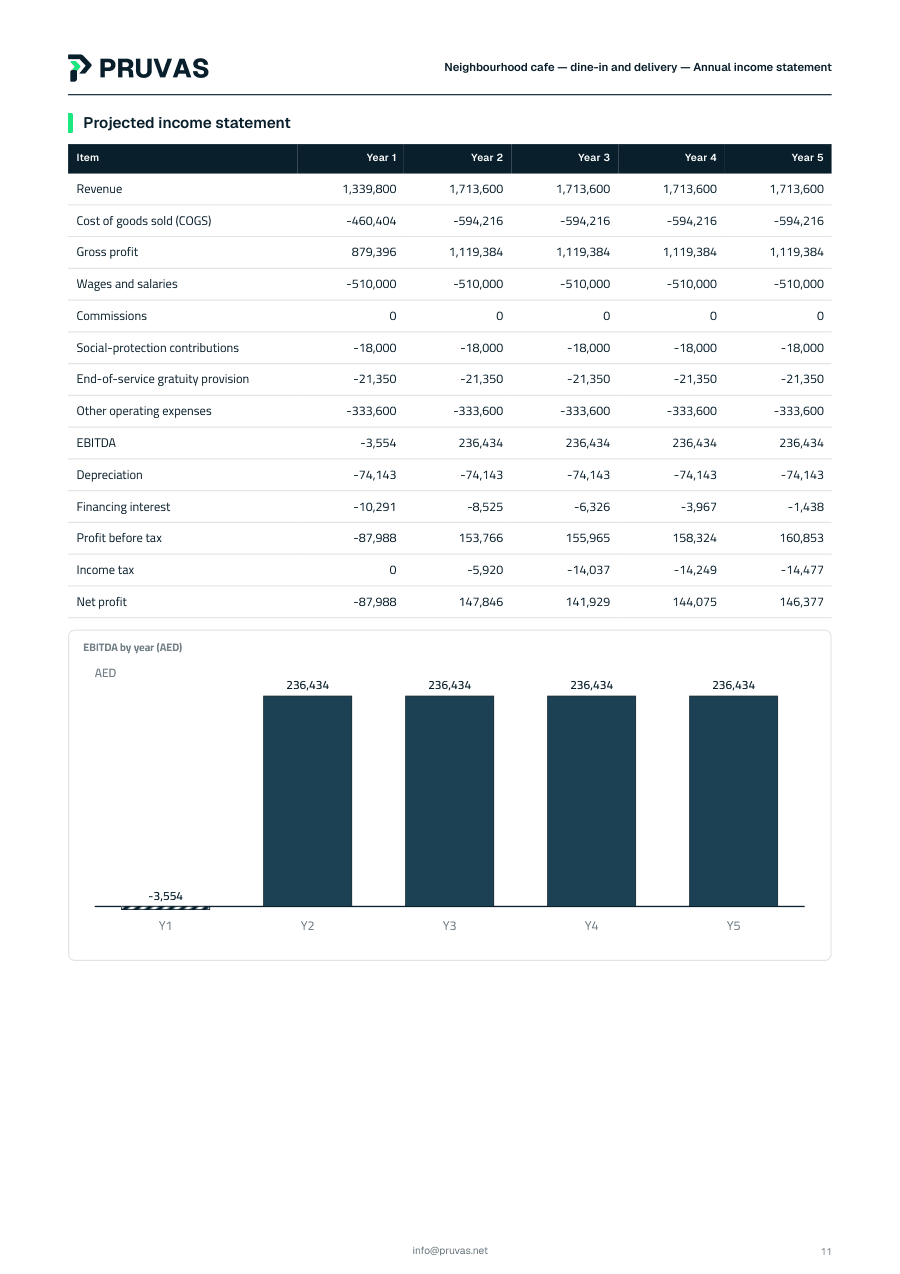
- Annual income statement and cash flows
- Investment analysis: NPV, IRR, payback and break-even
- A sensitivity table and a risk analysis
- Market, customers, competition and SWOT, with sources
- A statutory annex, and an assumptions and sources annex
An invented demo case, not a real client's study.

Pay once per report
The wizard, the preview and the AI helper within its limits are free. You pay only when you unlock the full report.
43.00USD a report
To compare two or three options, or plan a second site.
Every option includes:
- A narrative written from live research, every fact with its source
- The final PDF, without the preview watermark
- Free re-renders for 30 days after unlocking
- Unlocks that never expire
Questions
- Is this financial advice?
- No. Pruvas is a financial modelling and planning tool. It calculates what your numbers say and shows its assumptions; the decision is yours.
- Can I take the study to a bank?
- The study is built so an accountant or a credit officer can check every step, and the methodology is public. It is not bank-approved, audited or certified, and a lender may ask for its own review.
- Which countries does it cover?
- Any country. Oman is modelled with its labour, social-insurance and tax law and their citations. Elsewhere you enter the rates yourself, and the report says so.
- What does the AI do, and not do?
- It explains fields and suggests estimates with a reason; a suggestion enters a field only when you press Apply, and stays marked. It drafts a study from your idea and writes the narrative at unlock, with sources. It never writes a financial figure.
- What if the report fails, or I find an error?
- No refunds once unlocked. If a report fails for a technical reason, the unlock is not used, or we refund it. Any arithmetic error you report is investigated and the report regenerated free.
- Where is my data kept?
- In the EU. AI and search providers receive only the business details a task needs, and you can delete your account and studies in one click.
Start with one sentence.
The draft and the preview are free. You pay only if you decide to unlock the report.